US Business Bank Account for Non-Residents: The Essential Guide

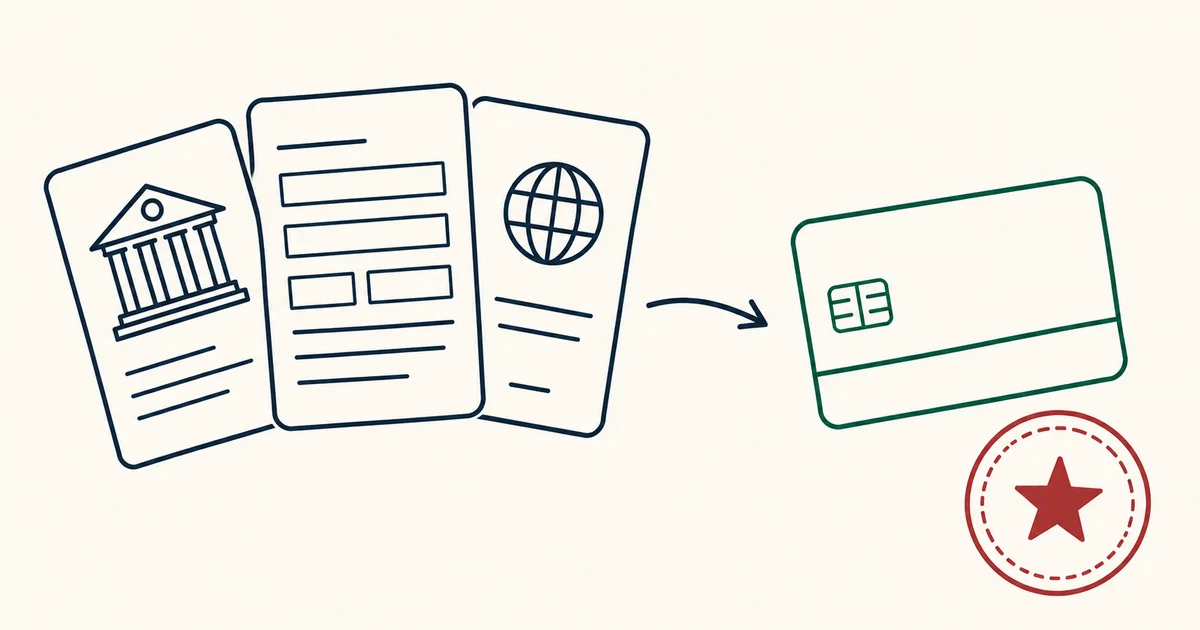
You can open a US business bank account as a non-resident, remotely, without visiting America. You need three documents: your Articles of Organization, your EIN confirmation letter, and your passport. Fintech providers onboard foreign-owned LLCs routinely. Ours was open in 48 to 72 hours.
Opening a US business bank account is the step where most guides become useless, because they were written for Americans who can walk into a branch. You cannot. And the traditional banks that dominate search results will, in most cases, decline you.
Here is what actually works, what documents you need ready, and why applications fail.
Table of contents

Mercury opened our account in 48–72 hours
Fully remote, no US visit, no friction as a foreign owner. Full detail below.
Can a non-resident open a US business bank account?
Yes. There is no citizenship or residency requirement to hold a US business bank account in your company’s name. What the provider verifies is the entity — that it legally exists, has a federal tax ID, and has an identifiable owner.
Your personal status matters far less than most people assume. You do not need a green card, a visa, an SSN, or a US address of your own — the company’s address is what appears on the application.
The obstacle is not eligibility. It is that most traditional banks require an in-person visit and have compliance departments that treat foreign ownership as a reason to decline rather than a situation to process.
US business bank account: the three documents you need
Every US business bank account application asks for the same core set. This is what ours required, and having all three ready at the point of applying is what made it fast.
| Document | Where it comes from | Common problem |
|---|---|---|
| Articles of Organization | Your state filing | Name must match the application exactly |
| EIN confirmation letter | The IRS, after Form SS-4 | Applying before it arrives |
| Passport | You | Must be valid and clearly legible |
The EIN comes from the Internal Revenue Service and is the one that trips people up. You cannot open a US business bank account without it, and as a non-resident you obtain it through the fax route rather than the online application — the process is documented in our EIN without an SSN guide.
US business bank account: traditional banks vs fintech
This distinction decides whether your US business bank account application succeeds.
| Traditional banks | Fintech providers | |
|---|---|---|
| In-person visit | Usually required | Not required |
| Foreign owner without SSN | Frequently declined | Routine |
| Approval time | Weeks | Days |
| Minimum balance | Common | Often none |
| Physical branches | Yes | No |
| Cash deposits | Yes | Generally no |
For a remote founder with no US operations, the fintech trade-offs cost nothing. You are not depositing cash in Ohio. What you need is a US business bank account that accepts wires, connects to Stripe, and opens without a plane ticket.
US business bank account providers compared
| Provider | Type | Non-resident friendly | Best for |
|---|---|---|---|
| Mercury | Business banking | Yes, routinely | Primary US account |
| Wise Business | Multi-currency | Yes | Getting paid in several currencies |
| Relay | Business banking | Yes | Multiple sub-accounts |
| Payoneer | Payments | Yes | Marketplace sellers |
These are not direct substitutes. Mercury and Relay are business banking platforms. Wise and Payoneer are payment and multi-currency services. Many non-resident founders run both — a primary US business bank account for operations, and a multi-currency service for receiving payments from clients outside the US.
Mercury — the US business bank account we use
Mercury is the account we opened for our own Wyoming entity, and it is the one we recommend for a first US business bank account.
The application was fully remote and completed in 48 to 72 hours. They asked for exactly three things: the Articles of Organization, the EIN confirmation letter, and a passport. There was no friction attributable to being a foreign owner — no request for a US phone number, no verification step assuming residency, no additional documentation because of our location.
That is the part worth emphasising. The process was not “difficult but manageable”. It was ordinary.
Strengths
- Fully remote onboarding
- Routine acceptance of foreign-owned LLCs
- No monthly fee or minimum balance
- Wire transfers in and out
- Clean interface built for startups
Trade-offs
- No physical branches
- No cash deposits
- Requires a formed entity and EIN first
Open in 48–72 hours, from anywhere
Articles of Organization, EIN letter, passport. That was the entire requirement.
Wise Business — for multi-currency

Wise is not a US business bank account in the same sense; it serves a different purpose. It gives you local account details in several currencies, which matters if your clients pay in euros, pounds or Australian dollars and you would rather not lose money on conversion every time.
It complements rather than replaces a primary account. The comparison with Payoneer is covered in Wise vs Payoneer for business, and Mercury against its closest competitor in Mercury vs Relay.
Getting paid outside the US?
Local account details in multiple currencies, without the conversion loss.
Why US business bank account applications get declined
Five recurring causes, in order of how often they appear.
Applying before the EIN letter arrives. The single most common failure. The entity is not verifiable without it.
A name mismatch. The company name on the application must match the state filing character for character, including the “LLC” suffix.
An address the provider rejects. Addresses flagged as high-volume mail drops raise fraud signals. This is why the choice of virtual mailbox provider matters more than its monthly price.
An unclear business description. Vague answers about what the company does trigger manual review. Be specific and plain.
Re-applying too quickly after a decline. Fix the underlying cause first. A second application with the same defect makes the file harder to approve later.
Frequently asked questions
Can I open a US business bank account without visiting the US?
Yes, with fintech providers. Mercury onboarded us entirely remotely in 48 to 72 hours. Traditional branch banks are far more likely to require an in-person visit.
Do I need an SSN or ITIN for a US business bank account?
No. The account belongs to your company and is verified through its EIN. Most non-resident owners never need a personal ITIN — see ITIN vs EIN.
What documents does a US business bank account require?
Three: your Articles of Organization, your EIN confirmation letter from the IRS, and your passport. Having all three ready at the point of applying is what makes the process fast.
How long does US business bank account approval take?
Ours took 48 to 72 hours with Mercury. Fintech providers generally decide within days; traditional banks take weeks and often require a visit.
Can I use a virtual address on the application?
Yes, if it is a real street address at a registered mail agency rather than a PO box. Addresses flagged as high-volume mail drops are more likely to trigger a decline.
Do I need a US business bank account at all?
If you want to accept US payments, use Stripe, or look credible to American clients, yes. It is also what separates business finances from personal ones, which matters for the liability protection the LLC is meant to provide.